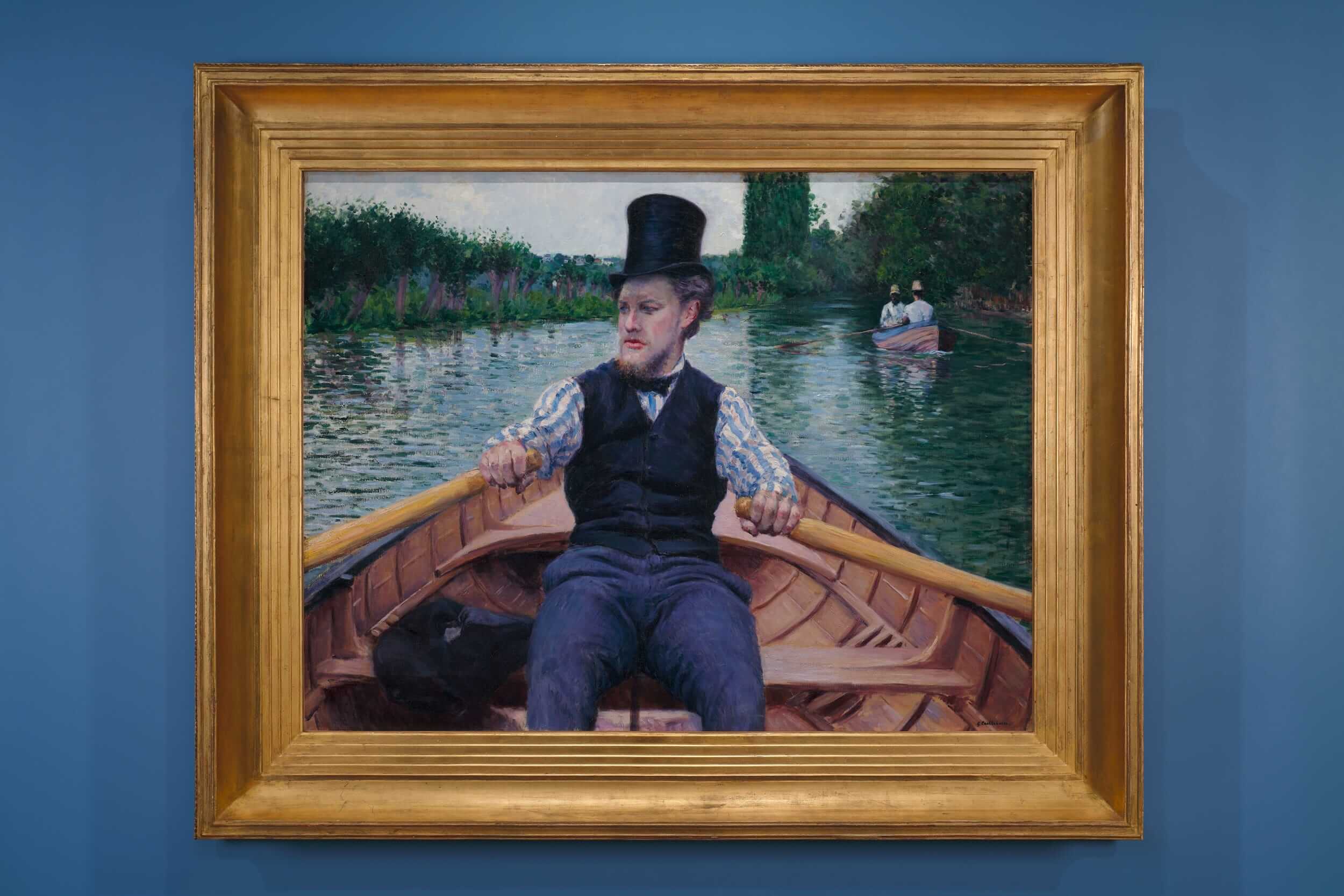
When Gustave Caillebotte’s works land at the flagship of Louis Vuitton in New York, something interesting happens: luxury retail becomes high-art stage. The exhibition climbs to the fifth floor of the brand’s 57th Street gallery and presents two paintings that trace a modern gaze: one, “Young Man at His Window” (1876), shows a suited figure looking out over a Paris street—steady, silent, observing; the other, “Boating Party” (c.1877-78), catches a man rowing confidently across the river, motion and leisure captured in sun-lit brushstrokes.
These works might not scream “Impressionism” in the familiar way, yet together they mark Caillebotte’s quiet revolution: a painter rooted in urban modernity, framing masculinity, leisure and solitude with equal curiosity. Beyond the frames, they mark a moment: the luxury group’s art-strategy plays out here, the galleries inside stores are no longer decorative add-ons but cultural statements. The paintings are on loan from major museums—the Musée d’Orsay in Paris and the J. Paul Getty Museum in Los Angeles—and their presence in New York turns a store visit into a quiet art pilgrimage.
In that space between branding and fine-art, Caillebotte’s quiet but precise brushwork, his framing of men in contemplative or active roles, speaks across time: from 19th-century Paris to the modern showroom, he asks us to see with fresh eyes. And the retail-gallery hybrid reveals another truth: that art, commerce and experience are a trio reshaping how we engage with both canvases and conversations.
Full Story: ELLE Decor